










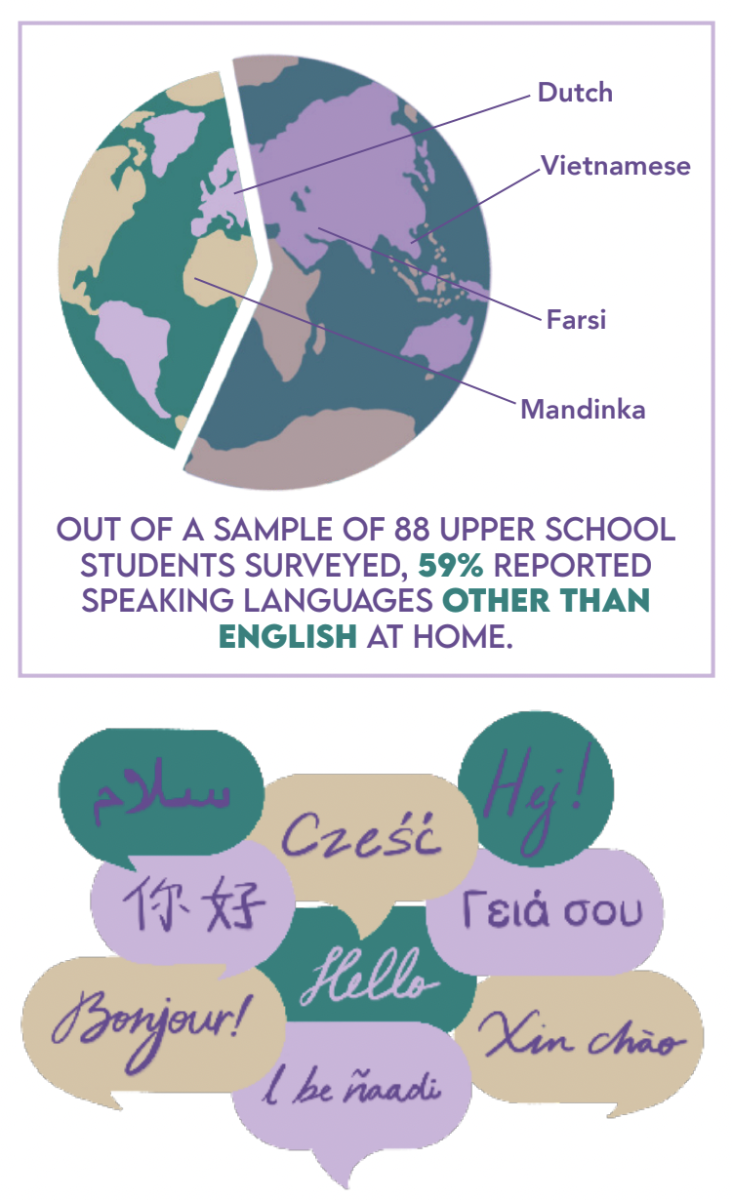
At school, Baldwin students may greet each other a “Hi,” or “Hello.” Yet, at home, they may greet and converse with their families in a variety of languages. For example, in the Mandinka dialect from West Africa, there is no direct translation for “Hello,” so instead, one may greet another with “I saama,” meaning “good morning.”
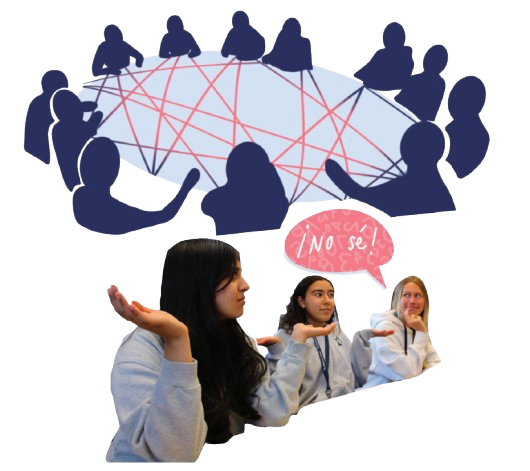
At Baldwin, Upper School students are required to take a world language for at least three years, or two years each of two languages. Yet, many students are able to speak an additional language, besides the one they learn in school. Out of a sample of 88 Upper School students surveyed 59% reported speaking languages other than English at home. In total, 20 distinct languages were represented, including Vietnamese, Polish, Farsi, and Dutch. For these students, there is a distinction between language learning as a requirement for school and language learning as a natural process passed down through family and culture.
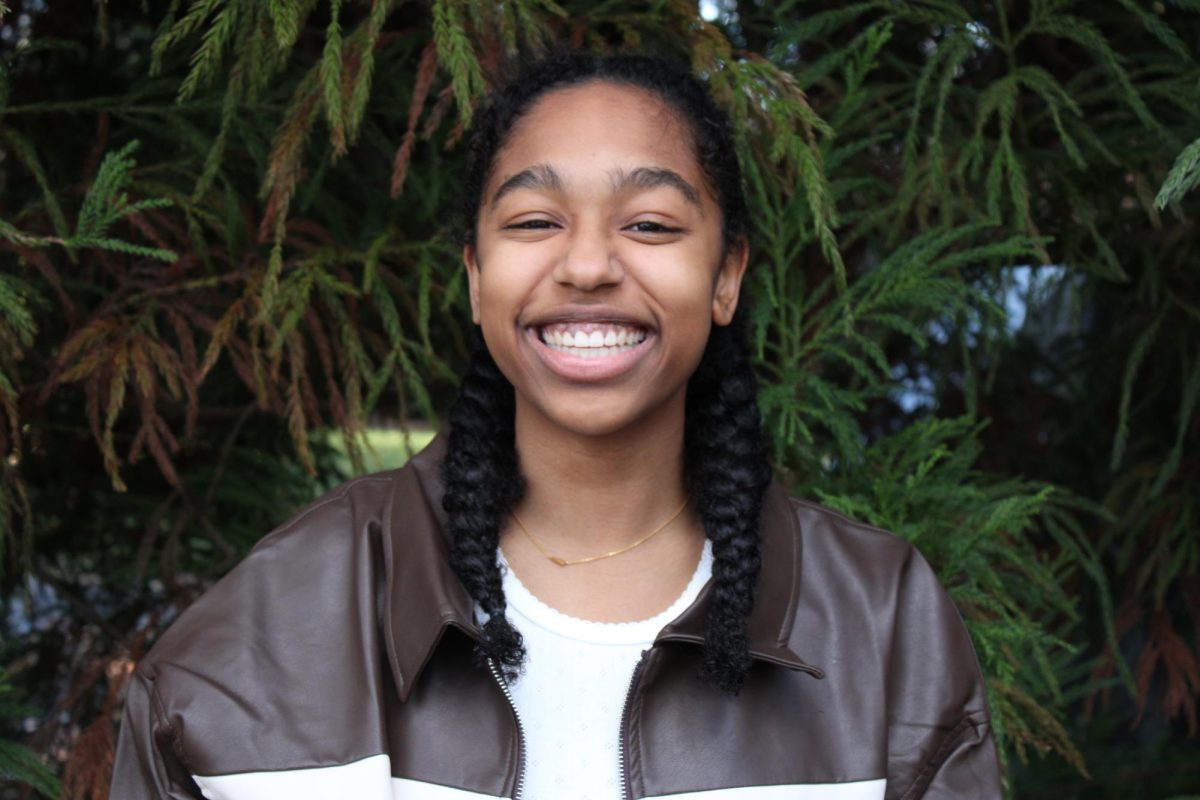
Fanta Sumaoro ‘27 speaks Mandinka at home, which she first learned from her parents when she was around six or seven years old. As a third-generation American, she is glad that this language has been preserved in her family, since she recognizes that dialects can die out, but are often essential to one’s culture and belonging.
“Even the name Mandinka, since Mandingo is a tribe, can show the language is the culture,” Sumaoro said. “There’s something in language that if somebody says “__,” that means you’re part of the tribe.”
Besides English and Mandinka, language learning is very instilled in Sumaoro’s family. Sumaoro’s father speaks French, Arabic, and Korean, and her mother speaks French.
Sumaoro takes French at Baldwin, partially because both her parents speak it, but also because she is Guinean, where many people speak French because it was colonized by France.
“I hope one day I can go back [to Guinea] and speak French to them,” Sumaoro said.
Another student, Lingxi Kong ’28, experiences language in a very different way. While Sumaoro can continue to connect to her culture and ethnicity when speaking Mandinka and French, it is harder for Lingxi Kong ‘28, who speaks Cantonese, a language from Guangdong and Hong Kong, China, to connect with Mandarin speakers, the majority of Chinese people.
Kong feels that her identity as an American often precedes her identity as a Chinese person, an idea that is further cemented by her lack of Mandarin speaking skills.
“When I visit relatives back at home, the assumption is always that I can speak Mandarin,” Kong said. “So then my mom, instead of saying, ‘No she speaks Cantonese,’ she says, ‘No, she doesn’t understand,’ which makes me sound like I only know English – which is frustrating.”
Like many American-born Chinese children, Kong attended Chinese school to learn to read and write in her language, but since only 5% of the Chinese population speaks Cantonese, Kong faced challenges with a curriculum that did not accommodate non-Mandarin speakers.
While only being able to understand around a quarter of Mandarin is a major source of frustration for Kong, she still feels grateful that she can speak multiple languages.
“Even if it’s not, like, as well as I can speak in English, I feel like that just opens the door to communication with my grandparents,” Kong said. “At least just a tiny bit of Mandarin – even if it’s not perfect, I’m just glad I have the ability, or the instincts to know what sounds right, so that I can develop this skill in the future.”
Melina Intzes ‘26, who speaks Greek at home and takes Latin, French, and Arabic at Baldwin, thinks language learning can expand beyond connecting with one’s own culture to problem solving and exploring other cultures.
For example, Sumaoro and Intzes were both able to apply their language learning to real life situations, with the French trip this March. Sumaoro even thinks she may teach her French correspondent some words in Mandinka when the French students come to the United States next year.
“When you learn languages, you learn to draw parallels between unknowns and familiarities very often,” Intzes said. “I think linguistics is integral to improving the way you see the world and the way you approach interactions with other cultures.”