
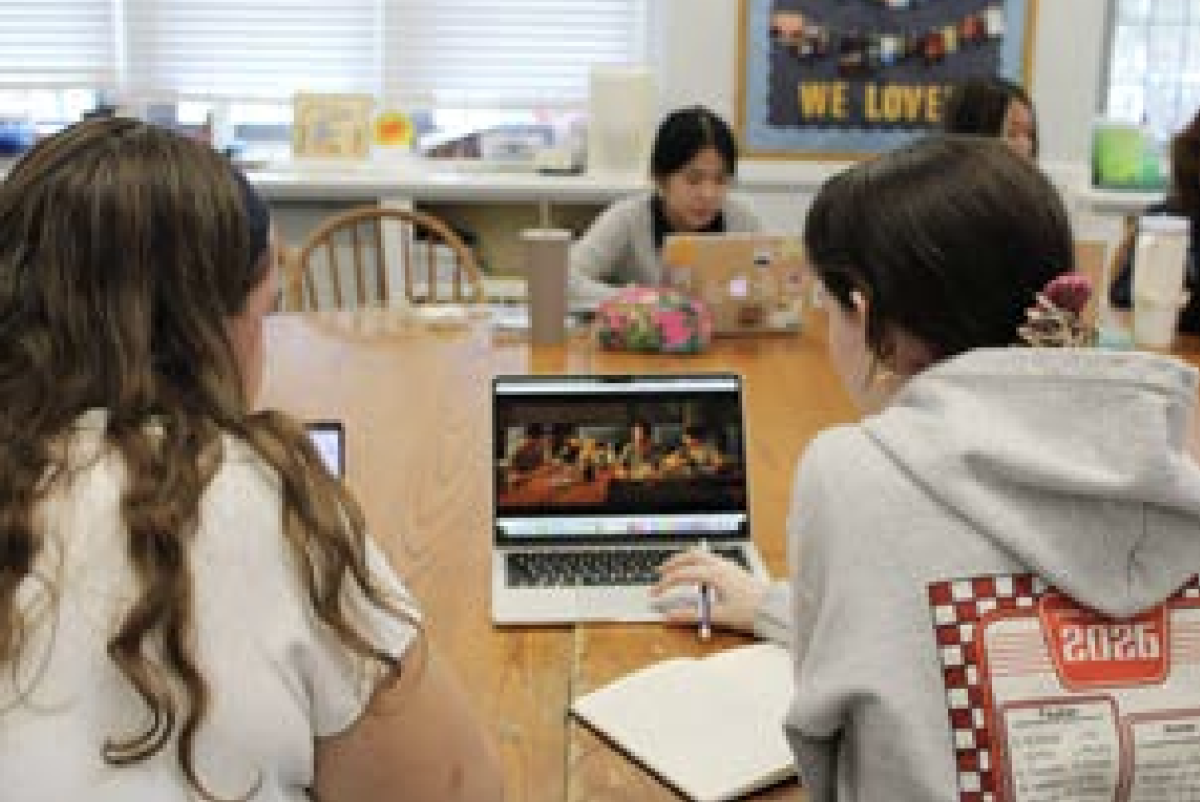













With the rise of social media and video platforms like TikTok, the amount of information and opinions individuals consume daily is at an all-time high. In a recent survey of The Baldwin School’s Upper School students, 95% reported using social media. Yet, how does social media impact students’ formation of opinions and retention of information?
Short-form video platforms allow information to be consumed at an extremely fast pace. On one hand, this can give diverse creators and ideas a platform, but on the other, it can make forming individual opinions extremely difficult.
According to Riya Shetty ‘29, the mass content available on social media makes it challenging to avoid falling into trendy thinking.
“I try not to be influenced, but it’s hard sometimes because it does play a really big part in our lives,” Riya Shetty ‘29 said.
Similarly, Emma Nguansiri ‘29 explained how social media encourages people to fit a certain mold.
“[Social media] has forced me into the standard of always mirroring what other people do,” Nguansiri said.
AI has further complicated this challenge, as an increasing number of AI-generated videos are falsely presented as real to promote certain agendas.
“I’m always questioning whether something is real or fake because of AI. Everything looks real at this point,” Cydnei Cristen ‘27 said.
Unfortunately, the beliefs pushed on social media are not only trendy, but often untrue and extreme.
Baldwin Middle School math teacher Ms. Lukens brought up her concerns about the types of opinions that social media promotes.
“The loudest voice is always the one that fills the space,” Ms. Lukens said. “I think the people who scream the loudest are often the ones whose views are kind of extreme. So [their videos] pull people into that, that may not just have a community or feel connected, and separate people.”
Teenagers and adolescents are more prone to fall into these beliefs, since they tend to follow trends and peer pressure.
“[Teenagers] are susceptible to hopping onto these ideas,” Baldwin Upper School history teacher Ms. Reichner said. “Especially during adolescence, the brains are still developing.”
The introduction of short-form video platforms has heightened this, leading to more passive thinking. This has created a new form of passive interaction: doomscrolling.
“[When on social media] I lose track of time, and I’m usually on it way longer than I think. It’s kind of something that I like to do so that I don’t have to do work,” Shetty ‘29 said.
In the same survey, almost 50% of students reported that social media has reduced their attention spans and made them more passive learners, leading to reduced critical thinking.
When using social media, students are exposed to unlimited amounts of information and knowledge without having to use their own words or research. From this, students have developed a new sense of impatience with new knowledge as they try to intake information in the easiest way possible, rather than the most beneficial or reliable way.
Thus, this exposure can also limit their ability to draw their own conclusions.
In response to this issue, Ms. Lukens encourages students to incorporate active learning in an age of passive learning. For example, instead of just writing down a definition, she suggests students think more about the definition and rewrite it in their own words.
“That is the active learning piece that we are starting to lose more of because passive learning has come; they’re so used to passive scrolling and getting information,” Ms. Lukens said.
The impact social media has had on classrooms extends beyond just reducing attention spans — it inhibits students’ abilities to grow as learners and thinkers.
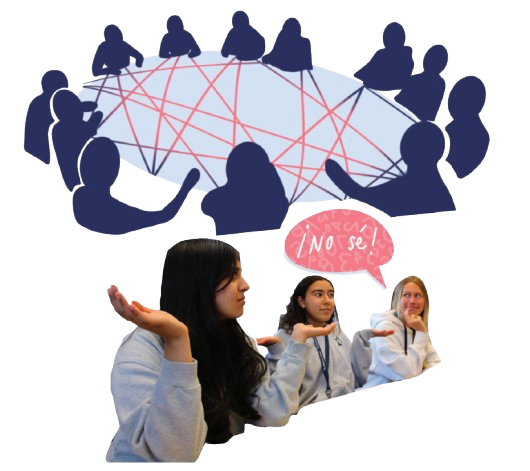
Despite these concerns, there remains hope for students learning how to navigate the confusing and challenging maze of social media and trendy thoughts.
“It’s not necessarily a bad thing to be influenced,” Ms. Reichner said. “As long as you’re willing to keep learning and keep an open mind.”