










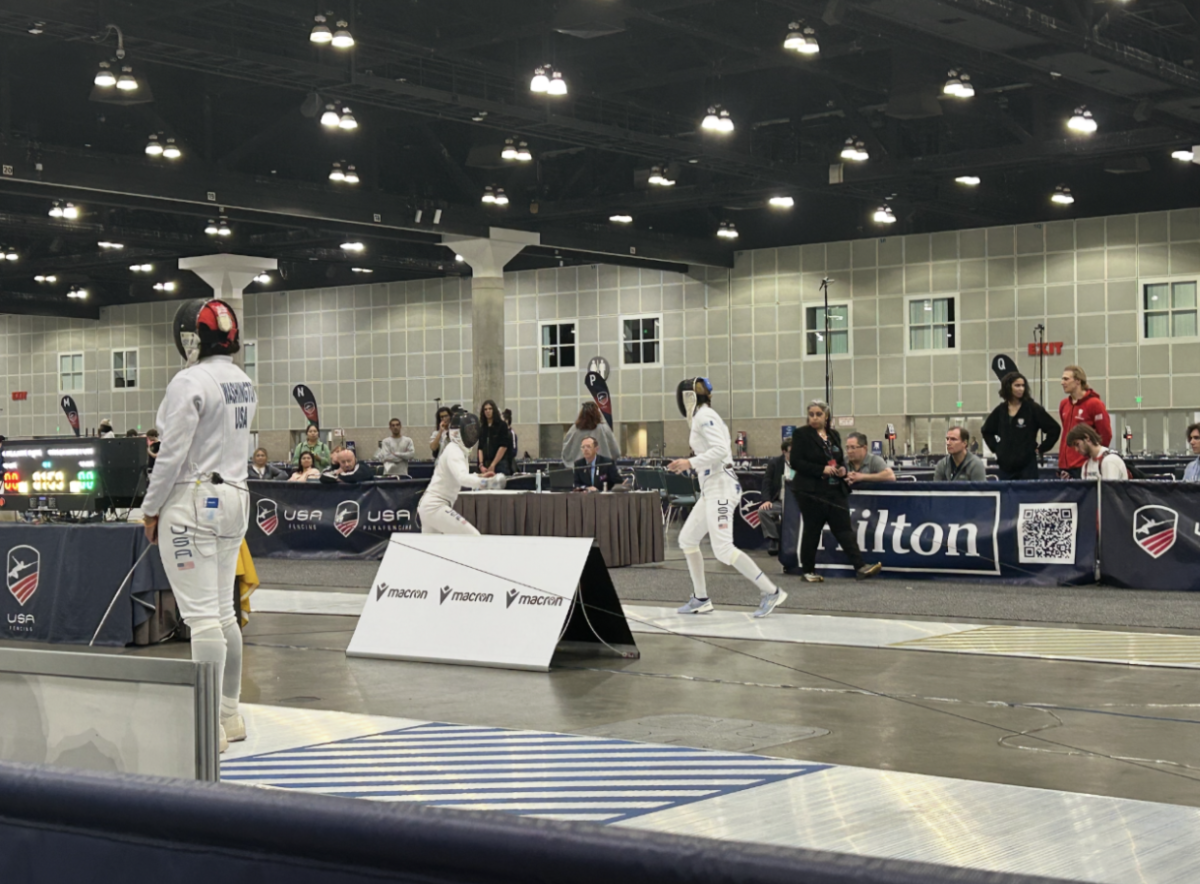


At Revolution Fencing Center (RFC), all of my teammates agree that fencing is one-of-a-kind: it’s a combat sport that requires coordinated attack-and-defense actions between two opponents.
Fencing dates back to the times of the ancient Egyptians and Romans and is now enjoyed by thousands of athletes worldwide, reaching an all-time high in popularity. It’s divided into three categories by weapon: epee, foil, and sabre.
“Although balancing academics is challenging with an intensive sports schedule, fencing teaches discipline, communication, coordination, and self-confidence,” my RFC teammate Marie Brown said.
Universally, fencing requires knickers, which are similar to pants, an underarm protector, a jacket, a mask, a glove, and body cords. However, each weapon has a different target area that fencers are required to hit in order to score points. Thus, other equipment is required depending on which type of fencing the athlete partakes in.
When the blade makes contact with the desired target area, the lightbox that the fencers are connected to via electrical wires will set off either a green or red light. This precise system demands the utmost focus, coordination, and perseverance.
Tournaments generally consist of two rounds: pools and direct elimination. In pools, fencers compete against four to six opponents in bouts to five touches. Once pools are completed, fencers are seeded depending on their performance. In the direct elimination bracket, they have to fence bouts to 15 touches until the final round.
This past summer, over 2000 fencers competed in the Summer Olympics in Paris, France. Many across the globe traveled to the city to watch their country’s athletes strive for a gold medal in the historic building, the Grand Palais des Champs-Elysée.
This year, the United States dominated the women’s foil. In the individual event, U.S. fencer Lee Kiefer competed against teammate Lauren Scruggs to obtain gold, while Scruggs earned silver. In the team event, the U.S. team also won gold.
Men’s epee fencer and coach Benjamin Bratton talked about his experience as a former member of the U.S. world team. He is the first African-American fencer to have won a world championship title for the U.S. By 2012, he had won 8 senior world championship medals.
Now, as the head coach at New York University (NYU), Bratton is focused on sharing his passion with young, ambitious fencers.
“I like seeing my students succeed and celebrating those moments together. The thing that I like more than anything is when someone achieves something that they didn’t know they could. It’s like a lightbulb goes off in their head,” Bratton said.
Doug Tableman, a head coach at RFC and a Division I men’s epee competitor, expressed similar thoughts.
“I enjoy seeing how excited people get about starting something that they didn’t think they could,” Tableman said. “Fencing is the best source of artificial hardship that I know of, and it’s a great way to build character.”
Unlike the traditional layout of fencing tournaments used by the International Fencing Federation (FIE), collegiate fencing, run by the National Collegiate Athletic Association (NCAA), is conducted slightly differently.
The NCAA championships are considered one of the most competitive tournaments in the world. A rigorous qualification round narrows the field to the top 23 collegiate fencers in the country. This round follows a round-robin format, where every fencer competes against one other to five touches, making for a highly unpredictable event. Based on these results, the top four are determined, and they fence off in bouts to 15 to determine the champion.
In NCAA fencing, top fencers compete to obtain a title that they can earn only four times in their career. From the combined performance of both men’s and women’s categories throughout the season, the University of Notre Dame earned its fourth championship title this year since 2020.
For me, fencing has been a life-changing experience. It’s allowed me to discover a side of myself I never knew existed, while also allowing me to travel around the nation and compete.
One of my main motivations in fencing is that it teaches me more than just techniques on the strip–it imparts valuable life lessons that I carry with me both in and out of the sport.
As a result, my confidence, perseverance, communication skills, and discipline have grown immensely in my academics and personal life.
There are plenty of fencers who share the same sentiments. A freshman at Temple University, Emily Faktor, spoke about how fencing has helped her throughout her college career.
“[Fencing has] helped me become more confident. I’m a lot more comfortable taking exams [because] I second-guess myself a lot less than before,” Faktor said. “To fence at your best ability, you have to have a stable mind, which I struggled with a lot..My coach gave me a lot of advice on that, so I’ve been trying to apply it more in my life.”
At its core, fencing is a sport that builds character in a healthy and rewarding way. Whether it’s getting your first medal, attending a fencing camp, or just showing up to practice and giving your best effort, there’s always something to find joy in. For Bratton, that joy comes from the sport’s fairness.
“What I love about fencing is that the winner is solely determined by how hard they worked…regardless of their background. I got pleasure from knowing that it was always even on the strip and that I could win despite my differences,” Bratton said.