

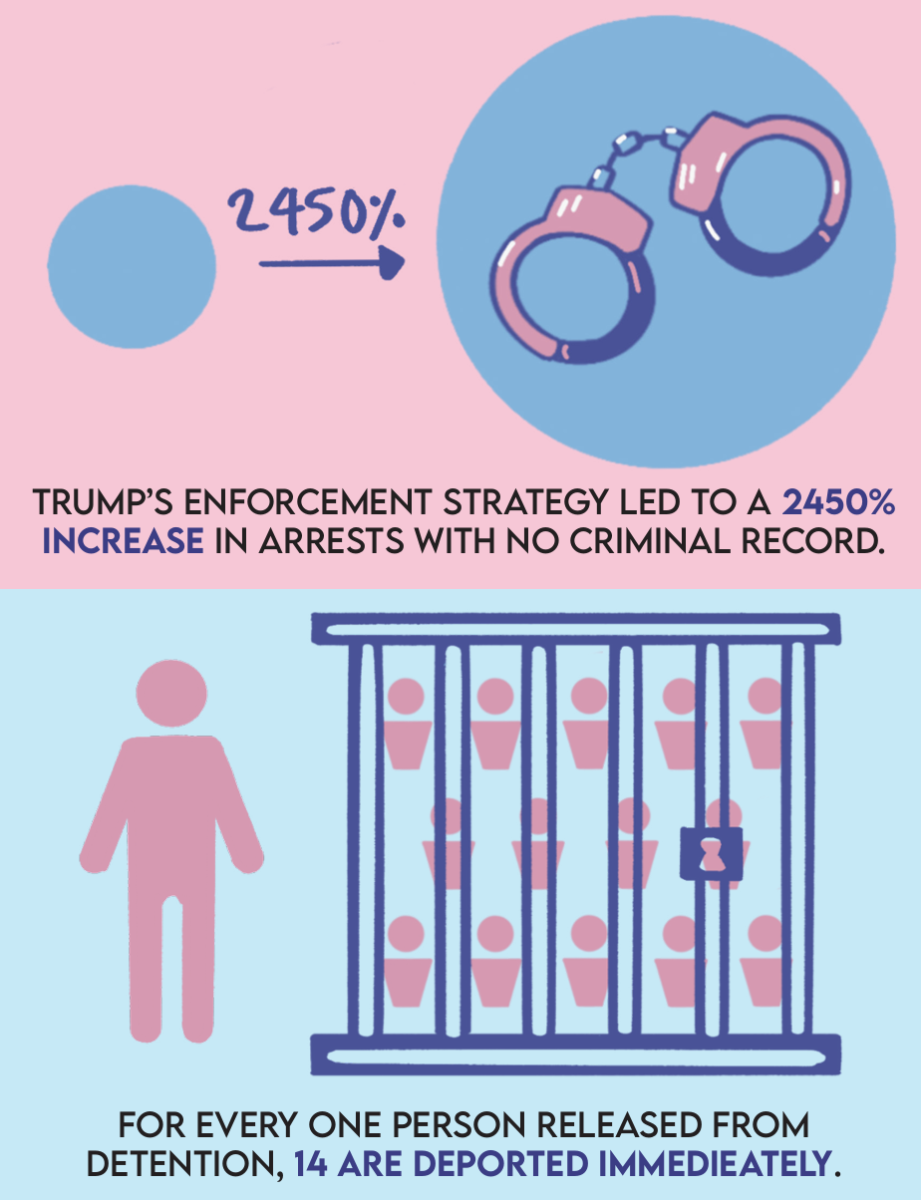









As debate over federal immigration enforcement intensifies, Baldwin students have found ways to stand up for what they believe in. In January 2026, protests began throughout the United States in response to fatal shootings of U.S. citizens by Immigration and Customs Enforcement (ICE) agents during an enforcement operation in Minneapolis. According to Reuters, thousands of people marched or participated in strike actions to abolish or stop funding ICE across major cities like Minneapolis, New York and Philadelphia.
Devyn Slaughter ‘26 was one such protester in Philadelphia. He attended an ICE protest in early January, following the shooting of Renée Good in Minneapolis. For high-schoolers, participating in protests is a growing form of activism. According to a 2020 UNICEF study, youth represented at least 25 percent of participants in more than 80 percent of protests from 1990 to 2020.
“There was a guy speaking at the top of the stairs, talking about why [ICE] is an issue and what people can do in their community – like reaching out to [government] officials and more,” Slaughter said. “There were a bunch of people shouting ‘Stop ICE’ and things like that.”
Slaughter mentions that in Dr. Biss’ Politics and Civics class, students reach out to officials about reforms, and enact change in their community about issues they care about as part of the curriculum.
“I feel like if I hadn’t taken that class, I probably wouldn’t have been as likely to go to the protest. But because I also had to fill it out for my checklist for politics, it was like a win-win situation,” Slaughter said.
Through this experience, Slaughter believes he was not only able to learn more about protests and activism, but also feel inspired by the willingness of people to protest.
“I learned that there’s strength in numbers,” Slaughter said. “No one knew Renée Good personally, but they all still came out to support.”
Dani Loveman ‘27, who participated in a protest in 2020 against the recounting of votes in that year’s election, also speaks to the factors that have brought her towards activism and the impact it has had on her.
“I was definitely inspired by my parents, who encouraged me to attend protests from a very young age growing up right at 12th and Chestnut [Street] in the middle of Center City,” Loveman said. “The active recounting of votes was happening relatively near to my house. I was actually interviewed on the news, that protest. I saw it then, the power of young protesters.”
While Loveman mentions the 2020 protest she attended as a particularly impactful form of activism, she also attributes learning about history in class as a way she gained a deeper understanding of why activism matters.
“Taking Politics and Civics this past semester, I learned more about elections and the whole process itself, protesting and like showing support is meaningful, especially in like the national narrative because progress is only going to be made, or pushed for, like with these recounts to be done and not have votes thrown, because of the show of public support,” Loveman said.
Amidst current events, Loveman has shown support for Anti-ICE movements as a head of the Hispanic and Latin Student Association and through social media.
“Right now, spreading awareness through social media is very popular, but I personally prefer making small changes within your community,” Loveman said. “I think [making change] now more than ever, especially with ICE specifically targeting the Hispanic community, even if it’s not necessarily directly impacting anyone at Baldwin. Like, showing that community that we have here makes it a more welcoming place. We’ll hopefully push for more Hispanic students and more celebration of culture.”
Loveman distinguishes social media as a more passive form in which she spreads awareness.
“For me, social media, I’m not personally creating any content, but since there is a big repost culture, I do think it makes an impact if you’re spreading information about ways to contact officials or specific protests or something that’s happening,” Loveman said. “I don’t think you are a bad person if you aren’t doing this. I don’t think shameful tactics, which have unfortunately bled into genuine awareness content, are effective.”
When advocating for change at school, Loveman has identified aspects that improve student awareness as well as some barriers. While Loveman appreciates Baldwin for exposing her to courses like Current World Issues, Politics and Civics, and U.S. History, she finds it hard to further awareness outside of the classroom.
“The Hispanic and Latin Student Association was talking about doing a presentation on ICE, but it kind of puts us in a hard position. We’re seeing our community impacted so much, but aren’t sure how truthful we can be, or how much we’re gonna have to sanitize the information,” Loveman said. “I think that when it comes to the whole school content, it does have to be somewhat sanitized to be palatable.”
Ultimately, there are many venues for students at Baldwin to become involved in activism. Some are built into the curriculum, or offered in various clubs and organizations. At the end of the day, activism uses collective action to bring about change, and any effort, whether large or small, in person or on social media, can contribute to that goal.
“All those people [at the protest] are different, or have differences, like, no one knew each other,” Slaughter said. “It just shows the different things people care about and how powerful things can become when we go out, come together and do things as a group.”