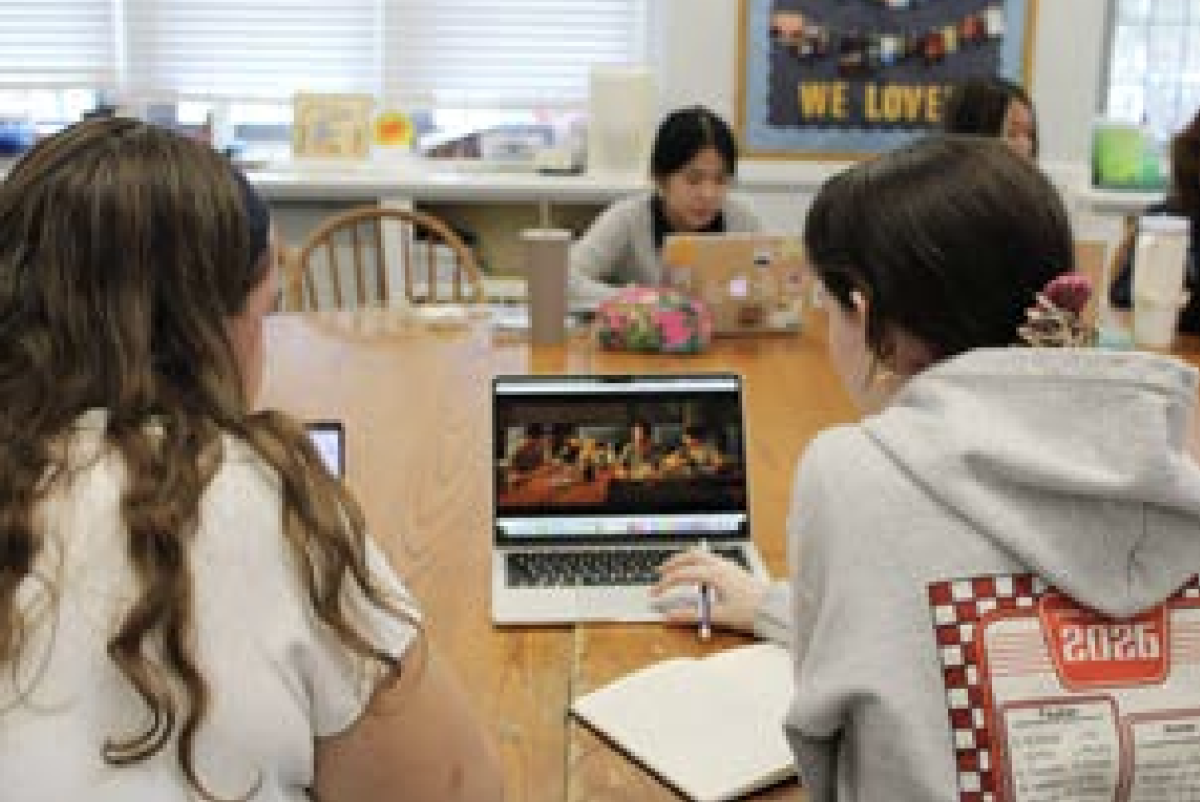













A student at The Baldwin School walks confidently down the English hallway. Pushing through the bustle, they make it into the room one minute before the bell rings. They sit down, take out their notebook and pencil and get ready… to watch the Academy Award winning film Parasite.
Baldwin’s Film Studies class is a half year of film, fun, and forensic ability. Officially added to the course handbook in 2025, it debuted as a full class during the 2025-26 school year, with nine students enrolled for the spring semester. Ms. Emily Davis, the instructor of Film Studies and chair of the Baldwin English Department, considered modern media and student development goals when conceptualizing the course.
“When we talk about what electives will be offered, we really try to think about what will appeal to students and what will give them different experiences with a variety of texts, genres and perspectives,” Ms. Davis said. “Film offers a different way for students to engage in texts because texts can be written, but they can also be [things] like visual text or audio visual text. Learning how to read different media as text and provide analysis is just another way to hone critical thinking skills.”
The elective course focuses on the active consumption of film as media, utilizing not only the writing-based elements like screenplay, but also visual elements like lighting, camera angles, and costumes.
“I learned how to analyze things with the absence of words, which helps you understand people better,” Stella Mrockowski ‘27 said.
The curriculum offers a survey of film, from early film and filmmaking to thematic analysis of film production. So far, the course has been received well among Baldwin students. Although it has only just begun starting from the second semester in January, Mano Thirumaran ‘27 considers it an entertaining way to engage with new media.
“It’s really good,” Thirumaran said. “We’ve done things like looking at older films from a historical lens and then seeing how that comes in [to play], plus [learning] the more literary themes and the different lenses of looking at a film and seeing it both as a historical primary source and also as an artistic work.”
Film studies explores different philosophies of filmmaking, and explores lenses such as historical, social, linguistic, and structuralist lenses. Ms. Davis’ aim with film studies is to help students discover the nature of film as both an influencer and a reflection of the world, leading to a careful selection process.
“I really tried to pick films that would interrogate those things, and I also tried to choose a variety of voices and perspectives,” Ms. Davis said. “Some of the films that I’m showing are early films that set standards in the Hollywood industry or explored the emergence of sound or light and shadow and things like that. Some of the films that I’m showing are more contemporary and actually pose questions to those earlier films.”
Film studies also aims to exercise students’ writing abilities, particularly to use writing as a tool to organize thoughts and communicate effectively. Thiruman notes the new writing abilities she would like to explore.
“I think I’ll learn how to write about pieces of media other than books in a way that is similar to how we read for English,” Thiruman said. “Watching films in the future will never be the same after Film Studies, as we develop a more critical eye to film language.”
As Film Studies continues to expand, students express their gratitude and appreciation for this new style of media literacy. The course opens their eyes to novel ways of criticizing modern media.
“Now I can better understand films,” Mrockowski said. “I better understand films not just as a form of entertainment, but also conveying a deeper message or theme, which I didn’t think about before [this class].”