














U.S. Immigration and Customs Enforcement (ICE) has taken on a pronounced role in national headlines, with recent incidents involving federal agents sparking protests and debate over immigration enforcement and human rights. In response, students at The Baldwin School reflect on ICE’s actions and their broader implications.
In just the past month, students have learned of the killing of 37-year-old Renee Nicole Good on Jan. 7, the detention of 5-year-old Liam Conejo Ramos on Jan. 20, and the fatal shooting of Minneapolis ICU nurse Alex Pretti by federal agents on Jan. 24. The killings of Good and Pretti have led to protests against ICE across the country while Ramos, who was taken into custody on his way home from school and transferred to a detention center in Texas, was returned home on Feb. 1. Both Good and Pretti were U.S. Citizens, while Ramos is an asylum seeker who entered America legally.
The agency, which is tasked with enforcing federal immigration laws in the United States, operates with more than 20,000 personnel across the country as part of the Department of Homeland Security. Following national outrage, the agency’s role and methods have come under intensified public scrutiny.
To understand how this news is resonating locally, students at Baldwin shared their perspectives on ICE, its enforcement tactics, and the impact on immigrant communities.
Dani Loveman ‘27 expressed strong concerns about the actions taken by ICE agents.
“The murders of both Mr. Pretti and Ms. Good are stains on American history,” Loveman said. “[ICE] is taking advantage of people who have a language barrier, are in deep distress, or just do not understand [their constitutional] rights.”
Many legal experts echo these concerns, arguing that certain ICE tactics violate the Fourth Amendment. Critics point to reports of officers using administrative warrants rather than judicial warrants to enter homes.
In response to these practices, The American Civil Liberties Union of Minnesota filed a lawsuit against the current administration, alleging that ICE unconstitutionally “ignored basic human rights in their enforcement” of their defendants.
Beyond legal concerns, students emphasized the emotional and physical impact of ICE enforcement. Emme Darlington ’27, who attended an anti-ICE protest in Delaware County, speaks to the extreme measures used by ICE agents.
“It is important to note that ICE uses unnecessary force, and agents often cover their face, which can send people into fight or flight,” Darlington said. “They remove people from their jobs, schools, and homes with such extreme measures that it is very normal for people to have an instinct to fight back … they do not deserve to be shot and killed for that.”
Claire Farrand ’27 shared a personal experience involving her grandmother, highlighting concerns about mistaken targeting and fear surrounding enforcement.
“My grandmother lived in Hawaii for many years and moved to Florida years ago,” Farrand said. “ICE came to her door and questioned her about when she moved to Florida, even though she’s a U.S.-born citizen.”
Other students acknowledge that ICE’s purpose is not inherently violent, but its execution has created unnecessary violence and fear.
“They need to stop being so violent, or people won’t know what ICE is intended for,” Marlayna Lichtenstein ‘26 said.
“The concept of it is okay. I know that anybody would want to detain people who have committed crimes, but their execution is horrible,” Annie Reed ‘28 said. “There should be zero violence and [the agency] clearly doesn’t [just] target criminals.”
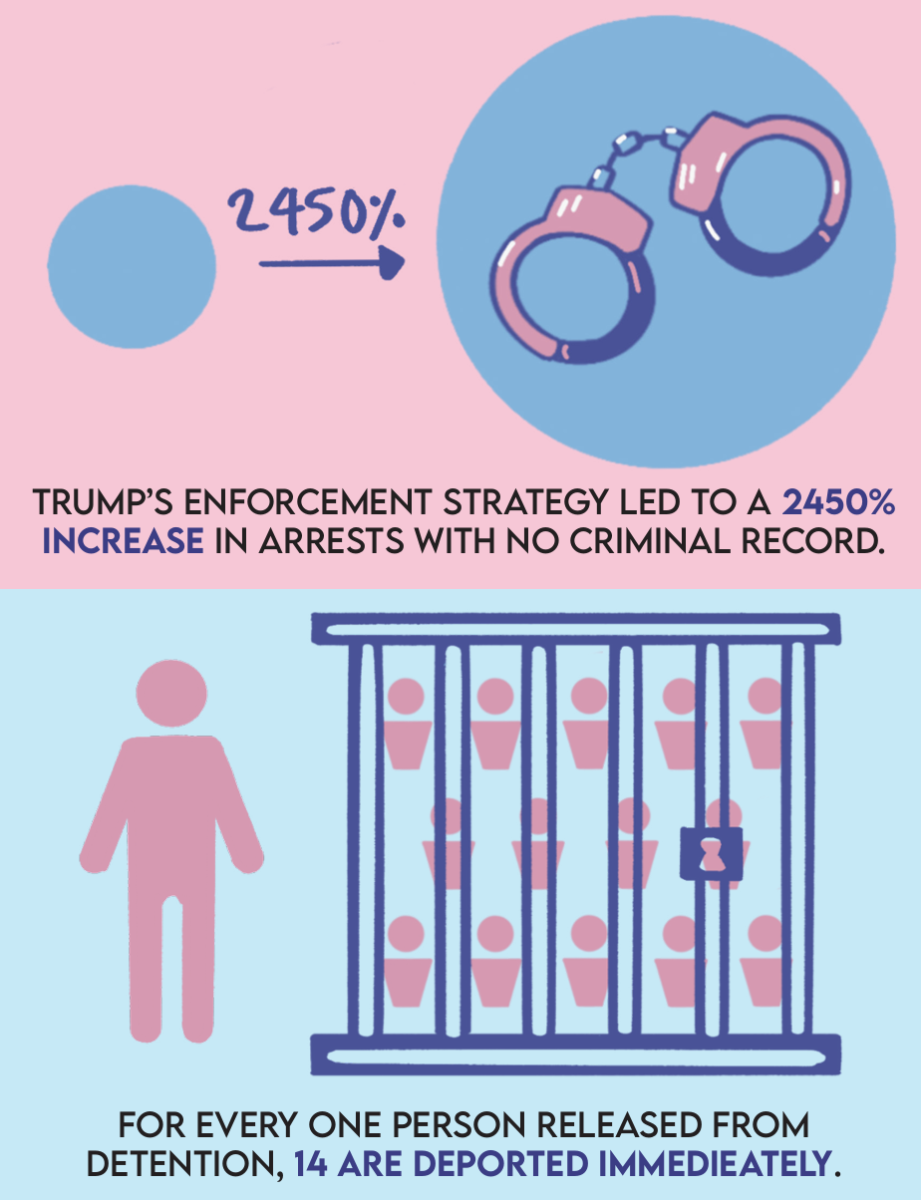
Concerns about ICE’s targeting practices are reflected in national data. According to the American Immigration Council, Trump’s “at-large” enforcement strategy led to a 2,450% increase in arrests of people with no criminal record, with only one individual released from detention to await trial for every 14 who were deported immediately.
Another issue raised by students is ICE’s presence in healthcare settings. Stella Mrockowski ’27, who completed a reform project in Dr. Biss’s Politics and Civics Course on ICE detaining individuals in hospitals, speaks to the negative impacts of this practice.
“[It is] really harmful to immigrant communities’ health, both mentally and physically,” Mrockowski said. “It leads to distrust. There are statistics that show immigrants are less likely to access healthcare in fear that they will be detained for simply being outside.”
According to a Chicago CommunityHealth facility that primarily serves immigrants, 30% of patients, approximately 300 individuals, did not show up for appointments or reschedule, due to fears surrounding immigration enforcement.
Camila Tobon ’26 reflected on discussions with peers in classes or in general about ICE.
“Their actions don’t really show us that they’re targeting criminals; it shows us the opposite.” Tobon said. “We spoke about ICE a bit in our Politics and Civics class, and it also comes up sometimes in the lounge. I feel like Baldwin students are open to discussing hard topics.”
“It’s good that we can have open conversations surrounding ICE at school,” Laila Gopalani ‘26 said. “I feel like I have learned a lot about people’s thoughts on the situation.”
“The sense of community that has been built surrounding these tragic events is inspiring and helps me keep just a little bit of hope,” Darlington said.