











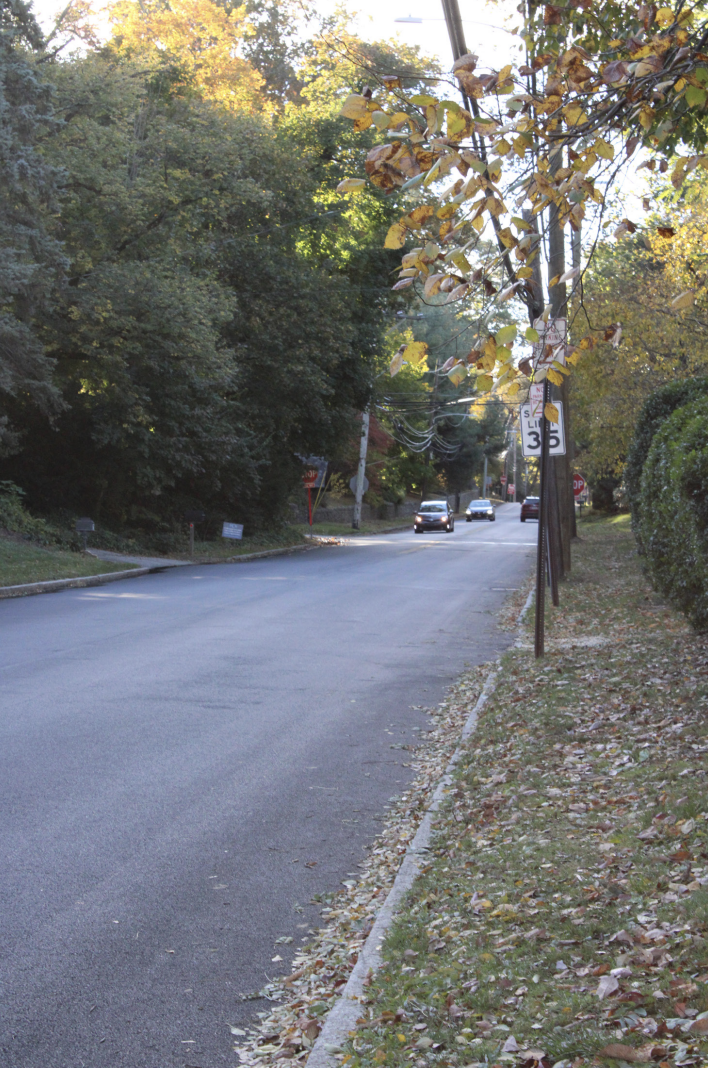
Once a student starts to leave The Baldwin School, they walk on a pristine white sidewalk for a mere 15 meters before wet grass squishes abruptly under their sneakers. The student continues home, stumbling over muddy rocks and stumps, dodging telephone poles and trees, and balancing on the narrow curb strip just a foot away from speeding cars on a busy fourway road.
This uncomfortable trek happens on the left side of Baldwin’s Athletic Center, where no sidewalk exists on the edge of campus. This poses problems for many community members, especially students who park or walk home from that side of campus.
“It definitely makes my parents nervous for me to walk home because of the traffic and how there aren’t sidewalks,” Sarah Reynolds ‘28 said.
Not only are there no sidewalks outside of the Athletic Center, but the adjacent New Gulph Road is long, busy, and leads to Bryn Mawr College, The Shipley School, and other main roads, making traffic especially heavy during drop-off and pick-up times. Adding a sidewalk outside the Athletic Center would benefit students like Reynolds and reassure families of their students’ safety and keep the community safer on the streets.
This raises the question: If sidewalks are so useful, why haven’t they been built on this part of campus, which is one of the main connections between Baldwin and the outside world?
The Athletic Center was built in 2005, when Baldwin had to follow Lower Merion Township’s building and planning rules for all construction in the Township. At the time, sidewalks were required on heavily traveled roads like New Gulph Road, where the Athletic Center sits.
However, there was a conflict between Baldwin and the Township, since Baldwin did not want to have those sidewalks put in. Therefore, meetings between the Township and Baldwin commenced, focusing on the negotiation of the sidewalk code.
“[Baldwin] didn’t think sidewalks were necessary,” said Chris Leswing, assistant director of building and planning at Lower Merion Township.
Leswing, who has worked there for over 20 years, oversaw infrastructure operations at various types of properties, including the construction of Baldwin’s Athletic Center.
According to Leswing, Baldwin representatives cited the removal of trees and limited number of pedestrians as reasons for exemption from the zoning ordinance.
Eventually, the township authorized the waiver. However, in the 20 years since the construction of the Athletic Center, Baldwin has had the power to add sidewalks without previous restrictions.
“They could install sidewalks by permit,” Leswing said. “It’s a relatively minor improvement and a pretty straightforward process after that. You just have to pay for it.”
Still, the process isn’t simple. Baldwin’s administrative process of planning and creating new infrastructure is lengthy and must go through many people before it reaches the project execution stage, which Baldwin’s Director of Facilities and Operations Mr. Keith Becklin is in charge of. Moreover, one of the reasons sidewalks have not been a priority is that the community has not made specific requests to Baldwin.
“This is the first I’ve heard of anybody wanting sidewalks there,” Mr. Becklin said.
Nevertheless, sidewalks are a possibility, if we work together to follow Baldwin’s established procedure for facilities improvements.
Before reaching Mr. Becklin, proposals are reviewed by the Strategic Planning Committee and the Board of Directors of Baldwin.
According to Baldwin’s strategic plan, section four of the Strategic Planning Committee’s pillars includes being “recognized for its innovative […] campus spaces” and “technology-rich spaces.”
While sidewalks might not be innovative, they would make the campus safer and more accessible. Baldwin could be recognized for helping to provide safe methods of transportation to community members, especially to the leaders that they are trying to uplift: students like Reynolds, who are the future of Baldwin.
“Even if it makes a difference for just a few people, it would still be beneficial,” Reynolds said.
In short, the path a leader takes will never be easy — but sidewalks can help.