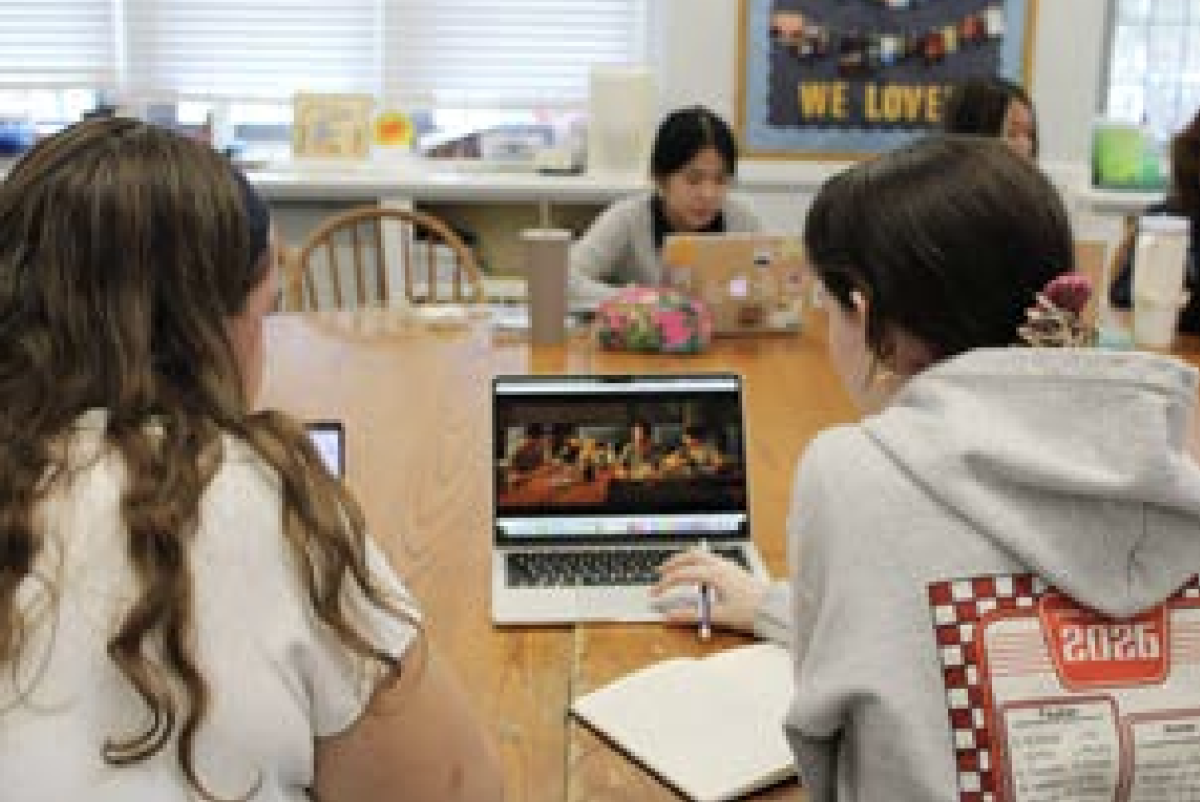




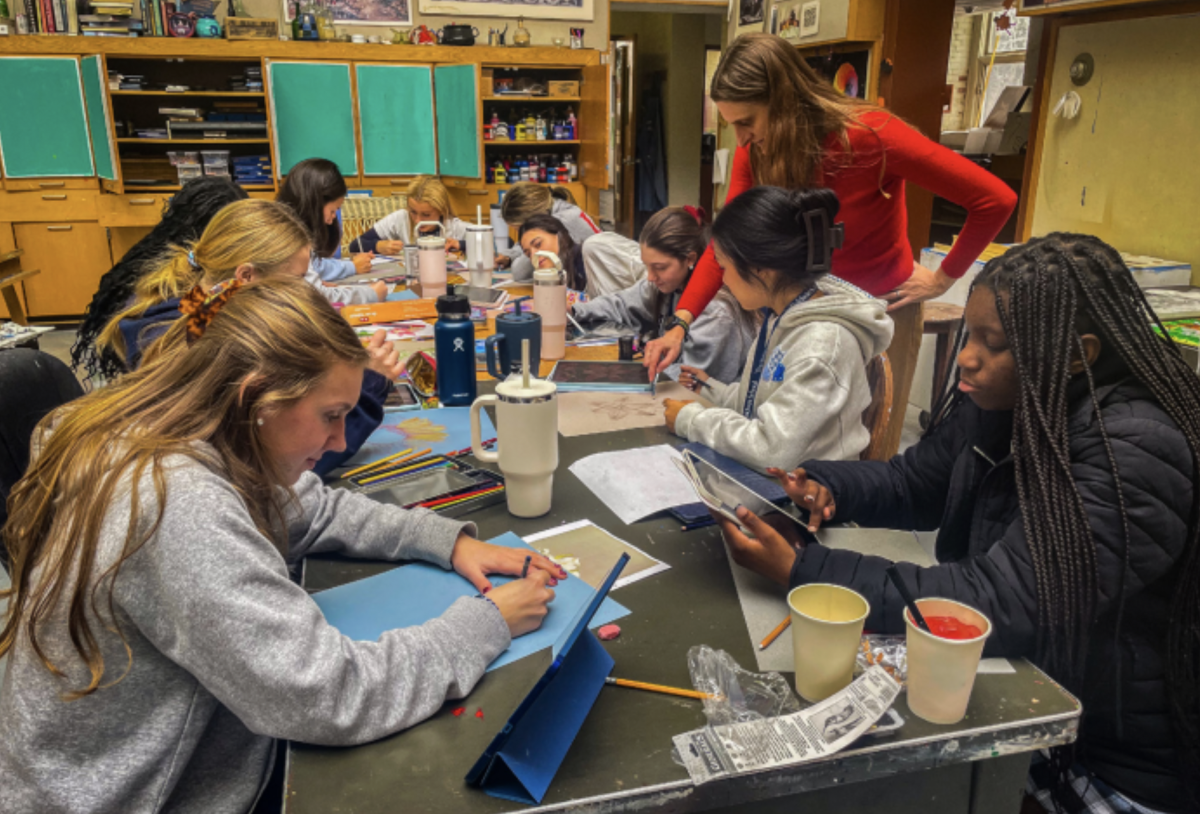
hones may be gone from Baldwin classrooms — but have iPads taken their place? Since the introduction of Baldwin’s new phone policy in the 2024-2025 school year, the presence of iPads in the Upper School has become increasingly more noticeable. Ranging from the size of a Kindle to a small MacBook, these small pieces of technology have taken over Baldwin’s community. This has sparked debate over whether iPads are effective learning tools or simply another source of distraction.
One prominent reason for their popularity is the note-taking capabilities and study benefits compared to traditional paper-and-pencil methods.
Eva Jiang ‘28 recently switched to an iPad this school year. With the large amount of information, notes, and workload at Baldwin, the iPad solved a big problem for her backpack and her back.
“I was writing a lot of notes, so I had so many notebooks in my backpack, and it was too heavy,” Jiang said. “Now, I just have to carry around my iPad.”
Nava Khojasteh ‘27 enjoys being able to take photos of worksheets and assignments and work on them online with her Apple Pencil. This feature helps her keep all her materials in one place, helping her study on the go in various locations.
“Having [an iPad] is really helpful because everything can be online,” Khojasteh said. “I can take it with me to tennis tournaments, and it’ll have all my stuff for me.”
Thus, iPads can be beneficial for students who have extracurricular activities to juggle outside of school.
Khojasteh also benefits from AI study apps on her iPad. One in particular helps her with preparation for assessments by making AI summaries of her notes and then creating quizzes based on them.
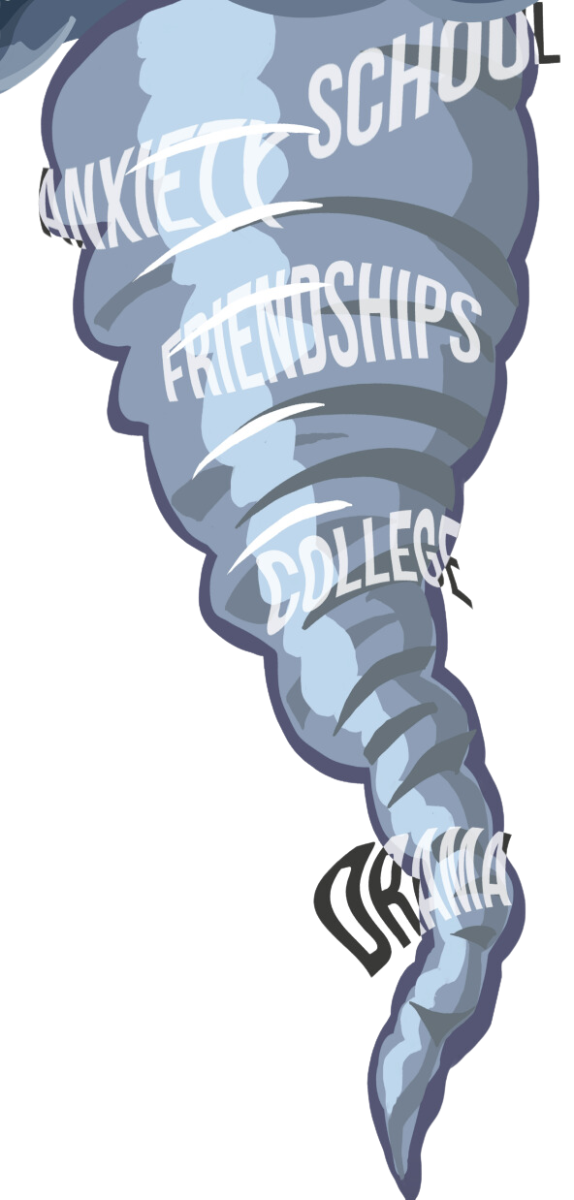
Regardless, both Jiang and Khojasteh recognize a downside to these tech-savvy tools: distractions. With iPads being virtually the same devices as iPhones — just larger — iPads have become a sort of “loophole,” allowing students to find entertainment and distractions during the school day.
“It’s just really easy for me to lose focus and shift towards something more entertaining with TikTok or social media,” Jiang said.
Teachers have also noticed changes with the uptick of iPad usage in the Upper School. For Spanish teacher Sra. Martha Ince, the popularity of iPads is a continuation of distractions that are present in all forms of technology.
“After my first year, I added a solid policy that no computers are allowed, because I had an unpleasant experience with the students who were using their computers for shopping and playing games,” Sra. Ince said. “I think [iPad use] is connected to the cell phone situation, but tangentially, it’s a combination of things.”
Math teacher Mrs. Mary Brennan acknowledges the benefits of iPads for her students in the classroom.
“[With iPads], students feel empowered to take notes from my instruction,” Mrs. Brennan said.
She attributes this empowerment to the iPad’s ability to help her students proficiently take notes with its many notetaking features when used with the Apple Pencil. However, she’s also noticed a problem.
“They’re more concentrated on their iPad, and there’s this absence of looking up and then down,” Mrs. Brennan said. “They’re just writing too much. And I really see it in the assessments; they are not coming out well.”
Most importantly, Mrs. Brennan believes that being successful with the iPad is a matter of balance.
“If you balance, I think there are good outcomes,” Mrs. Brennan said. “Is it a level of aptitude that some kids know how much to write, and other kids are writing too much?”
Sra. Ince similarly believes that students could benefit much more from the traditional paper and pencil, but explains a different reasoning.
“[Students] would definitely benefit much more from handwriting, because studies from experts indicate that the connection between learning and handwriting is stronger [on paper] than iPads,” Sra. Ince said.
Additionally, a much more hidden issue lies within the iPad: the problem of equality.
Art teacher Mrs. Mira Ramchandani has observed the disparity evident with these expensive devices.
“Do we think having an iPad is a privilege?” Mrs. Ramchandani said. “Is it like the new iPhone in middle school, where only select people can have one?”
Sra. Ince also raised this concern by wondering whether the popularity of iPads is more attributed to personal need or want.
“We probably shouldn’t allow iPads unless there’s a strong reason for this student, for their learning situation, that they would benefit from it,” Sra. Ince said. “But if it’s just for fun and because it’s fancy and ‘I like it’ and ‘it’s more convenient for me,’ that’s not enough of a reason.”
These observations by teachers and students have contributed to a larger discussion about technology and its new role today. As the difference between technology being helpful versus harmful to education becomes blurrier, one question is clear: where do we draw the line?