















Figure skating, also known as ice skating, is one of the few sports that bridges the gap between art and sports. Through expressive routines and stunning tricks, skaters create their own persona on the ice and conjure emotions. Now, figure skating is arguably the most popular sport in the Winter Olympics.
“Ice skating has taught me to be resilient, and you can’t let yourself get too down on setbacks,” figure skater Louisa Yin ‘28 said. “It’s taught me to pick myself back up and reevaluate mistakes to recognize that they weren’t as bad as they seemed.”
According to a Britannica article, in 1772, English author Robert Jones was credited with being the first to discuss skating as both an exercise and an art. Over time, the sport evolved from a stiff and strict style to a freer and more poignant dance. This shift sparked a movement in the 1860s that caused the sport to rise to significant popularity in countries in Europe.
As the sport began to gain popularity, the International Olympic Committee introduced ice skating to the 1908 London Winter Olympics, and the sport proved an instant success. Figure skating has been one of the most celebrated features within the international space.
According to the United States Figure Skating Organization, scoring in figure skating involves a technical panel consisting of specialists who record each routine with audio for review by judges. Each competition allows for a maximum of nine judges. Every program is assigned a base value that reflects its difficulty, which serves as the foundation for the skaters’ scores. Skaters aim to achieve the highest execution score possible, as this can adjust the base values of their elements.
In addition to the element score, judges evaluate three key program components: composition, presentation, and skating skills. These components assess the arrangement, artistic demonstration, and technical execution of the skaters’ routines. Ultimately, both the element score and the program components contribute to the overall segment score, which determines the winner of the event.
Yin discussed her experience of being in competitions in the past and how she managed them.
“Competitions can be stressful, and I wouldn’t say that they’re necessarily fun all of the time, but learning how to manage the stress in them makes it easier for me to deal with smaller stresses in everyday life, like at school,” Yin said.
Despite its simplistic nature, ice skating includes a variety of equipment to ensure safety. For starters, skaters must ensure that the ice skates they have selected are the correct level and fit so that they are suited for the proper level of performance. Additionally, skates have to be consistently sharpened.
Baldwin figure skater Brenna Knox ‘27 described some of the tedious equipment care that is needed for successful skating.
“The primary necessities are the boots and blades, along with all the accompanying equipment,” Knox said. “The laces on the skates need to be changed regularly, the blades on the skates require sharpening once a month, and the blades require both hard and soft covers.”
Not only does the skate have to be the correct fit, but so does the main attire for the routines. Generally, attire can range from $100 to $500 and usually must match the theme of the routine being performed. According to a Business Insider article on the costs of being an Olympic figure skater, skaters can spend anywhere from $500 to $5000 for costumes, skates, and beauty alone.
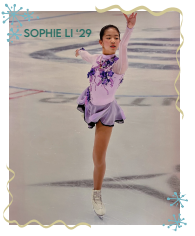
All of the ice skaters at Baldwin shared an intrinsic motivation and passion for the sport, each describing their unique perspective on what makes skating so special to them. Sophie Li ‘29 was one of the many who expressed their love for skating.
“I feel like ice skating’s progress can be slow, and it’s sometimes hard to measure because it can fluctuate a lot,” Li said. “It has taught me that perseverance is the most important. Sometimes, it can feel like I’m not progressing as much as I want to. Yet when I look back, I realize how much I’ve actually improved, and I can appreciate my hard work.”
Former skater Sophia Tang, a member of the class of 2028, expressed her thoughts on figure skating, emphasizing the unique aspects of the sport. She reflected on the beauty and artistry that set figure skating apart from other athletic activities.
“I think that ice skating is a combination of grace and athleticism,” Tang said. “I think that’s what differentiates it from other sports, because you have to jump and spin, but at the same time, you have to look graceful, and you can’t look tired. You also have one chance, and that’s your score. In basketball, you can take multiple shots; in this sport, you only have one chance to make it count.”
Li, Tang, and Knox each have their favorite moments as figure skaters. Some described their first time landing their first axel, which is a jump that requires skaters to spin one and a half times midair before landing back on the ice gracefully.
“When I landed my first axel, it was so thrilling because of the hard work you go through to succeed on a trick like that,” Tang said. “It’s very rewarding, and it has a lot to do with working with what you have.”
On the other hand, Li expressed her favorite moment as a recent achievement that she had accomplished earlier this year with her teammates.
“My favorite moment is probably from last summer when my team and I won nationals, and it was a really emotional moment,” Li said. “By winning nationals, we had finally beaten a team that we had been competing against for a while. We didn’t believe we would be able to beat them, but we did it.”
With the Milan Cortina 2026 Winter Olympics approaching, athletes from all across the globe are preparing for this momentous event. Both Li and Knox expressed their anticipation for the upcoming Olympics, and both have skaters whom they plan to support. Each of them expressed their enthusiasm for decorated figure skaters, such as Amber Glenn, Ilia Malin, Alysa Liu, and Madison Chock and Evan Bates.
At its core, figure skating is a sport that highlights athletes’ artistic expression and individual athleticism. It teaches athletes to trust the process and believe in their hard work and ability to succeed. Through their experiences, Yin, Knox, and Li each illustrate the grace, strength, and dedication that define figure skating. The magic of gliding across the ice with every spin and jump tells a beautiful story of realized dreams and unwavering commitment.